

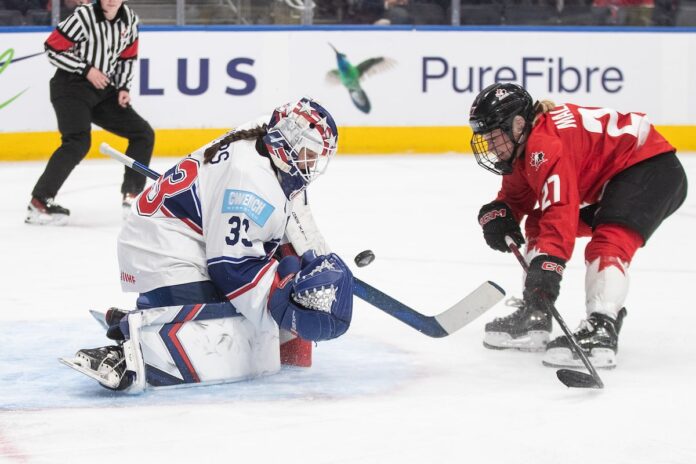

The U.S. women’s hockey team is demonstrating dominance in the Rivalry Series against Canada, showcasing their superior skills in preparation for the 2026 Winter Olympics. While both teams are grappling with the constraints of the Professional Women’s Hockey League’s schedule, the U.S. appears to be managing both Olympic preparation and series victories more effectively.
U.S. Takes the Lead in Rivalry Series
In the three games of the Rivalry Series so far, the U.S. has outscored Canada, 20-6. As the teams approach the fourth and final game in Edmonton, Canada is hoping to reclaim some momentum. This will be their last face-off before the Milan Cortina Olympic Games in February. However, the U.S.’s early lead suggests they are better prepared, both in terms of individual skill and team dynamics.
Impact of the Professional Women’s Hockey League
The Professional Women’s Hockey League (PWHL), which launched its third season in November, has changed the landscape for both teams. Prior to its existence, Canada’s pre-Olympic practice involved a six-month centralization of players in Calgary, with regular team games against minor hockey male triple-A opposition and even Junior A before the 2022 Winter Games in Beijing. This practice largely contributed to Canada’s Olympic gold victories since the turn of the century. But the PWHL, while fulfilling a long-held dream of players by providing a league that pays a living wage, may be impacting Canada’s Olympic preparation.
U.S.’s Edge in Speed and Skill
The U.S. team has long been recognized for its individual player speed and skill, which is particularly evident in their potent power play. Canada’s superior team game, honed through centralization, has often given them the advantage in Olympic finals. However, the shift in training due to the PWHL might be affecting this balance. Despite this, Canada’s head coach Troy Ryan remains optimistic, stating, “They’ve got a ton of youth, they’ve got a ton of speed, they’ve got a ton of skill,” adding, “It doesn’t mean you can’t be successful against a group like that, but to do it you’re going to have to compete, you’re going to have to play with structure.”
Rivalry Series: A Test for the Olympics
Canada’s approach to the Rivalry Series indicates a focus on Olympic evaluation and experimentation. The team started third-string goalies in its first two games, suggesting the goal was more about assessing player performance under pressure than scoring victories. However, a 10-4 loss to the U.S. in the third game, a record for the most goals Canada has ever conceded to the U.S., suggests there’s significant work ahead for the Canadian women to defend their Olympic gold medal.
Looking Ahead
With the PWHL resuming on Tuesday, there’s little time left for Canada to refine its team game. The league won’t break for the Olympic Games until January 28, leaving the players with a tight schedule. Canada’s first Olympic game is on February 5 against Finland in Milan, Italy. As the teams prepare for this global sporting event, the results of the Rivalry Series will undoubtedly weigh on their strategies and training.
