

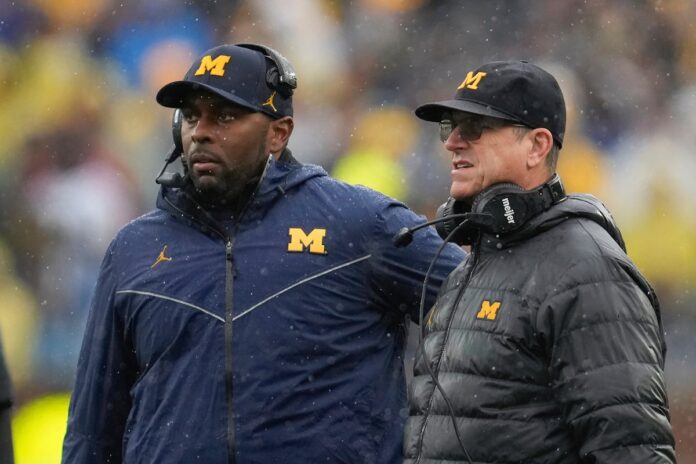

U.S. college athletics remain the closest thing sport has to a lawless frontier, especially when it comes to the big-money, high-stakes world of college football. The recent controversy surrounding the University of Michigan football program, its head coach Sherrone Moore, and the subsequent fallout is a perfect case study of this phenomenon.
Controversy Engulfs University of Michigan Football Program
Michigan’s head coach, Sherrone Moore, found himself in the throes of a scandal that shocked the world of college football. The former offensive coordinator was accused of engaging in an illicit relationship with a staff member, leading to accusations of stalking and home invasion. The case drew international attention due to its lurid nature, but it was far from an isolated incident in the world of college football.
The Complex History of Michigan Football
Michigan football has a history of controversial figures and events. Moore was promoted to head coach after his predecessor, Jim Harbaugh, was implicated in a sign-stealing scandal. Harbaugh’s predecessor had been charged with computer crimes related to stealing photos and videos of athletes. Despite these scandals, the team has continued to perform on the field, securing a spot at the Cheez-It Citrus Bowl under the interim coaching of a hedge-fund manager named Biff Poggi.
The Wild West of U.S. College Sports
While these scandals might seem shocking, they are not uncommon in U.S. college sports. The high-stakes world of college athletics often turns a blind eye to cheating, as long as the teams continue to win. This mentality has resulted in a sports culture that often mirrors a lawless frontier, with little to no repercussions for those who cross the line.
College Football and Academia: An Unhealthy Marriage?
Interestingly, the primary institution that should ideally act as a guardrail in this context – academia – often ends up becoming subservient to the sports program. The University of Michigan, like many other football powerhouse institutions, attracts thousands of students each year not just for its academic programs, but for the experience of being part of a big-time college football culture.
The Real Cost of U.S. College Sports Culture
This sports-centric culture comes at a cost. In order to attract top talent, colleges have resorted to offering lucrative Name, Image, and Likeness rights to star athletes. Michigan’s current quarterback was lured away from LSU with an offer of US$3-million. Moreover, this culture of ‘pay to play’ has now seeped into the American high-school ecosystem.
The Impact on University Reputation
While the football program might bring in revenue and prestige, it also raises questions about the ethical standards of the institution. The recent scandals involving Michigan football, for instance, paint a picture of an institution that seems to operate without rules. This raises questions about the university’s commitment to its academic mission and the values it instills in its students.
Conclusion: A System in Need of Reform
While college football is a deeply ingrained part of American culture, the recent scandals highlight a system in dire need of reform. The focus on winning at all costs and the absence of a strong regulatory framework has led to a culture of impunity that threatens the integrity of the sport and the universities that host these programs. It’s time to rethink the role of athletics in academia and ensure that sports programs operate within a framework of integrity, fairness, and respect for all participants.
