

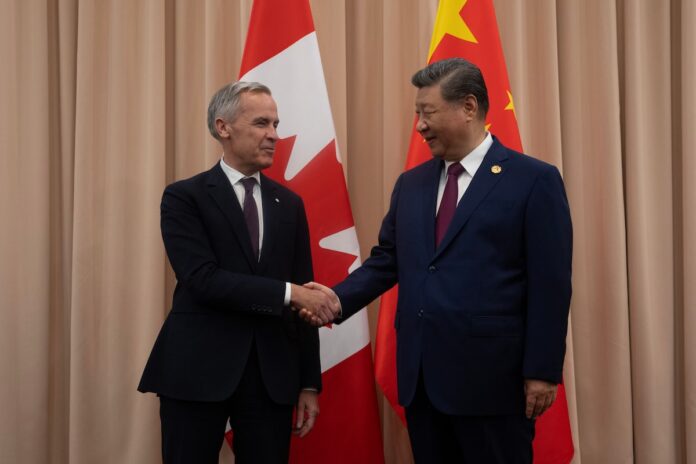

Global Affairs officials are currently in China preparing for a potential visit from Prime Minister Mark Carney. The visit could present opportunities for Canada to strengthen trade relations and seek new export markets, after years of strained ties and restrictions on Chinese state-owned companies’ operations in Canada.
Canadian Delegation in China
Senior Global Affairs leadership and a parliamentary aide to Prime Minister Mark Carney are in Beijing to set the groundwork for his potential visit next year. The delegation includes Deputy Foreign Affairs Minister David Morrison, Parliamentary Secretary to the Prime Minister Kody Blois, and Aaron Fowler, associate assistant deputy minister for international trade and chief trade negotiator at the Department of Global Affairs.
Foreign Affairs Minister Anita Anand explained that the visit by Mr. Morrison and others is partly in response to an October invitation from Chinese President Xi Jinping for Mr. Carney to visit Beijing. She added that the bilateral relationship between Canada and China is complex and requires addressing numerous points of discussion before a leader-level visit can take place.
Trade Relations Between Canada and China
Canada and China are currently embroiled in a significant trade war, sparked by Ottawa’s decision in 2024 to impose 100-per-cent tariffs on Chinese electric vehicles, a move that mirrored the then-Biden administration’s actions. As a result, Beijing retaliated by applying heavy levies on a variety of Canadian products, from canola seed to seafood and pork, causing significant economic harm across the country.
Despite the ongoing trade dispute, Ms. Anand could not confirm whether Beijing and Ottawa might reach a resolution in 2026, stating that trade issues were only one aspect of a very complex relationship.
Canada’s Strategy to Diversify Its Trading Partners
Ms. Anand emphasized Canada’s need to diversify its trading partners and not to be overly reliant on any one market. To illustrate this, she referred to her work with Pakistan earlier this year to resume canola exports to the South Asian country. This move illustrates the process of diversifying supply chains and not putting all of Canada’s eggs in one basket.
The dispute over EV tariffs between Canada and China is also tied to Ottawa’s efforts to address the protectionist U.S. tariffs on Canadian goods imposed by the Trump administration. There is a risk that the Trump administration could react negatively if Ottawa decided to scale back the EV tariffs.
Canada’s New Foreign Policy Approach
Canada’s new foreign policy, led by Ms. Anand and Mr. Carney, is marked by pragmatism and a sense of urgency. The basis for Canada’s external relations currently is the need to shift trade away from the United States. The primary aim is to double non-U.S. trade over the next decade.
In October, Mr. Carney and Mr. Xi met on the sidelines of the Asia-Pacific Economic Cooperation summit in South Korea, marking the first formal meeting between a Canadian prime minister and the Chinese President since 2017. This meeting was a culmination of months of efforts by the Carney government and Ms. Anand to mend relations with major emerging markets like China, which accounts for about 5% of Canadian exports.
Overall, Canada’s foreign policy objectives include standing with Ukraine in the short and long term through various forms of aid, diversifying trading partners to avoid over-dependence on one economy, and ensuring collaboration with like-minded countries in this multipolar world.
