

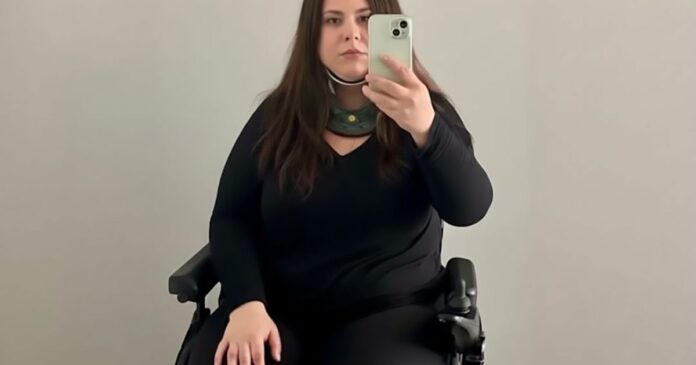

A Toronto resident, Tiffany Felkai, is struggling with a rare and debilitating disorder known as Ehlers-Danlos Syndrome (EDS), which has left her skull detached from her spine. Despite her desperate pleas for intervention, Ontario’s health care system has refused to provide the vital corrective surgery she needs. The system’s failure to address her medical needs has left her in constant pain and forced her to rely on expensive private clinics outside of Canada.
Tiffany Felkai’s Struggle with Ehlers-Danlos Syndrome
Felkai has been living with the distressing symptoms of EDS since her mid-20s. Her plight has been further compounded by the Ontario Ministry of Health’s (OMH) failure to avail her of the necessary treatment. In an interview with blogTO, Felkai recounted her frustrating journey of self-advocacy, detailing the numerous roadblocks thrown her way by the OMH.
She first started experiencing symptoms of EDS during her childhood and early 20s, with a formal diagnosis being made in her mid-20s. Despite genetic testing which Felkai asserts provided conclusive proof of her EDS, her results were disregarded by Toronto’s Good Hope Ehlers-Danlos Clinic, leading to a series of misdiagnoses and further delay in her treatment.
Rapid Health Deterioration
Felkai’s health took a significant turn for the worse in 2017, following a minor injury and a subsequent viral illness. This left her with limited strength and the inability to walk. Her professional life was also greatly affected, forcing her to drop out of university where she was undertaking academic upgrading. She had to deal with a series of misdiagnoses, including Guillain-Barré syndrome and myopathy, amidst claims by doctors that her symptoms were simply a product of ‘functional disorders’ — a term used to describe physical symptoms that appear as a result of mental distress.
A Ray of Hope from U.S. Specialists
In her quest for answers, Felkai engaged a medical case management agency and was referred to a U.S.-based neurologist specializing in EDS. The specialist not only confirmed her EDS diagnosis but also identified the specific type she had based on her genetic mutation. Moreover, they discovered that she had developed Cervical Cranial Instability (CCI), a condition associated with EDS. In this condition, the ligaments connecting the upper vertebrae to the skull are loose, necessitating the use of a neck brace and leading to a myriad of symptoms including severe headaches and brain fog.
Ontario Ministry of Health’s Rejection
Despite this new diagnosis, the OHM stuck with the previous diagnosis from local doctors, leaving Felkai unable to pursue the recommended treatment options. “We exhausted our options within the Canadian healthcare system, even neurosurgeons who, typically on paper, would be the correct ones to manage this condition, were just essentially shutting it all down, not even just not offering surgery, but not wanting to offer any treatment, or not even wanting to acknowledge the diagnosis,” said Felkai.
Desperate Search for Treatment
Felkai’s only hope for treatment is a procedure known as occipital cervical fusion. However, the operation, which involves the permanent fusion of the skull to the spine to prevent dislocations that create pressure on the brainstem, was not approved by the OHM. The Ministry cited her layered diagnosis history as the reason for denying her application for the operation. Despite repeated rejections, Felkai continues to advocate for herself, seeking political support and raising public awareness about her condition and the lack of support from the healthcare system.
The High Cost of Treatment
With the OHM refusing to fund her operation, Felkai’s only remaining option is to pay for the surgery out of pocket in the U.S. The pre-surgery invasive testing alone is estimated to cost between $40,000 to $50,000. On top of that, she is also looking at an additional $10,000 in associated costs for travel and personal support care. The total cost for the full procedure could reach mid-six figures, a staggering amount for someone who is already surviving on disability income.
Conclusion
Felkai’s story puts a spotlight on the struggles faced by patients with rare disorders like Ehlers-Danlos Syndrome. Despite Canada’s high taxes meant to ensure universal healthcare, patients like Felkai are left to fend for themselves, battling not only their physical ailments but also the roadblocks presented by the healthcare system. As Felkai continues her fight for treatment, it remains to be seen how the Ontario Ministry of Health and the Canadian healthcare system at large will respond.
