

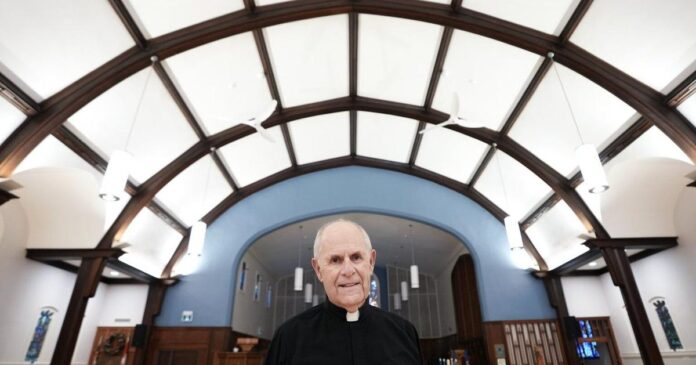

No faith in fossil fuels? Why some religious leaders are speaking out on climate change. The reason behind this is the growing urgency and moral obligation felt by these faith leaders to act against the continuing environmental degradation. In particular, Anglican Deacon Michael Van Dusen, an 80-year-old faith leader from Toronto, has become a face for this movement, taking his protest against the fossil fuel industry to the steps of a Toronto courthouse.
Deacon Michael Van Dusen: An Unexpected Climate Activist
For the first time in his life, Deacon Michael Van Dusen was arrested and charged with trespassing during a sit-in at a Royal Bank of Canada branch, protesting the bank’s fossil-fuel financing. He believes that Canadian banks are choosing to ignore climate science to profit from the destruction of the planet, thereby violating his moral obligation to care for the earth as affirmed by his baptismal covenant.
“We are here because we have a different view. We care about the planet and its inhabitants. We value it as a gift of our Creator,” Van Dusen proclaimed in front of a painted banner reading ‘no faith in fossil fuels’. He further emphasized, “We want to live in harmony with Creation. We are here because we are motivated by love, not profit.”
The Role of Faith Leaders in Climate Activism
Van Dusen, who co-chairs the spiritually-minded Toronto group Faith and Climate Action, is among a rising number of faith leaders globally who are speaking out, and even facing arrest, for their climate activism. They believe that science and economics alone cannot bring about the necessary changes, and a moral and spiritual dimension is equally crucial for the cause.
“What churches and faith groups bring uniquely is care for our neighbours. And in this case, our neighbour is all of Creation. It’s all the people, not just people in our community, but people all around the world who are affected by climate change,” said Van Dusen.
Engaging in Direct Action
Van Dusen’s group, Faith and Climate Action, has been involved in organizing various protests and demonstrations, including a mock funeral and sit-in at the headquarters of RBC. They also released an open letter, signed by over 100 Canadian faith leaders, urging the government and corporate bodies to stop investing in new oil-and-gas pipelines.
Other Faith Leaders Joining the Cause
Many other faith leaders have also been using their platforms to raise awareness about climate change and advocate for environmental stewardship. For instance, Irshad Osman, an imam in Toronto’s east end, teaches Islamic teachings that hold humanity as God’s stewards on Earth, accountable for any ecological damage.
Roman Catholic Bishop Jon Hansen, who attended the UN climate summit, known as COP30, in Brazil, shared his experiences of how climate change is reshaping his diocese and the struggles of Indigenous peoples, both in the Amazon and Canada, to preserve their land.
Challenges and the Way Forward
Despite the passion and commitment of faith leaders like Van Dusen, climate change has often taken a back seat to other pressing issues. However, they believe that faith leaders can use climate change as a common ground to re-establish strained partnerships and elevate the issue above political score-settling.
“We, even as a church, a big mainline Protestant church, aren’t going to move the needle. What we have to do is build coalitions,” said Van Dusen, emphasizing the need for collective action to effect meaningful change.
While the road ahead is challenging, faith leaders like Van Dusen are determined to continue their fight against climate change, driven by their deeply-held belief in the sanctity and preservation of the earth.
