


A nascent plan to boost Canada’s military reserves by as many as 400,000 is more about building a civil emergency relief force than preparing volunteers for combat operations, Defence Minister David McGuinty says.
General Jennie Carignan, Chief of the Defence Staff, has said she hopes to present options to the Carney government by spring for a national mobilization plan in what would be a sweeping expansion of the country’s reserves.
Mr. McGuinty, in a year-end interview, said the mobilization plan is important but not his top-line priority right now. Instead, he said, his chief task is rearming the Canadian Armed Forces with the injection of more than $80-billion over the next five years that was outlined in Ottawa’s November budget.
“The priority right now is to go out and recruit 12,000 to 15,000 additional members of the regular forces and the reserves,” he said. “The priority right now is to rebuild 33 bases,” the minister added, as well as tending to the military’s health care system, its recruitment efforts and other files.
“We are focusing on the big priorities first,” Mr. McGuinty said.
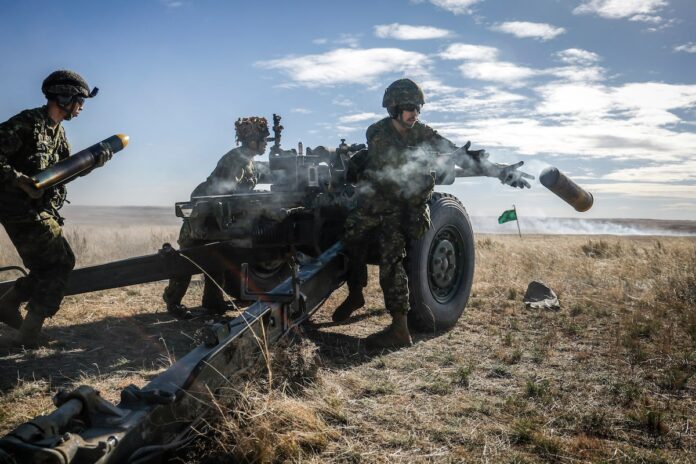
Soldiers of the 41 Canadian Brigade Group train at CFB Suffield, Alta., last year.Jeff McIntosh/The Canadian Press
Ottawa aims to improve Arctic communications with new defence agency’s first procurement
Minister of National Defence David McGuinty says the mobilization plan is important but not his top priority right now.Darren Calabrese/The Canadian Press
The mobilization plan has yet to be approved or funded. When it comes up for consideration, it will be addressed, he said.
He praised Gen. Carignan’s efforts and said she’s trying to capitalize on a wish among Canadians to serve their country.
“When I talked to my former colleagues in public safety in Quebec and Ontario, they both set up separate organizations to deal with civil emergencies, and they both told me, independently of each other, how shocked they were with the speed with which these were filled” by volunteers, he said.
He said the reservists would be far from full-time. “They want to be there on weekends. They want to help on certain evenings − they’d be on call, they’d be of assistance in different situations,” Mr. McGuinty said. “So that’s what I think the CDS is trying to engender here in terms of her efforts.”
Civil emergencies such as pandemics and forest fires and flooding have in recent years turned to the Forces for help.
The work-in-progress mobilization plan proposes an increase in primary reserve numbers to 100,000 from about 23,500 today, and a supplementary reserve increase to 300,000 from about 4,300 today. The supplementary reserve these days consists of former CAF members who have said they would be willing to respond to a request for help.
Ottawa announces regional investment initiative to help Canadian defence companies scale
A directive on the plan signed by the Chief of the Defence Staff in May envisions using these extra reserves to handle everything from “low-intensity natural disaster response to high-intensity large-scale combat operations.”
In July this year, former British army chief General Sir Patrick Sanders told The Telegraph that Britain must prepare for the possibility of war with Russia by 2030. A few weeks earlier, Germany’s chief of defence General Carsten Breuer told the BBC that members of the Western alliance NATO need to prepare for a possible attack from Moscow within the next four years.
Mr. McGuinty said threats this country is facing come from actors such as Russia, but he could not estimate the prospect of Canada being embroiled in a war with Moscow in the next five to 10 years. He also wouldn’t speculate on whether Russia’s expansionism would stop after Ukraine.
He nevertheless flagged Moscow as a key threat.
“The Russian regime has made a decision to transform their economy into a war economy. I think that they are acting with serious aggression. They are showing no signs of slowing down,” the minister said. “One of the reasons why we are reinvesting, re-arming the Canadian Armed Forces is to deal with this unfortunate reality, which is that there is, it’s the world is becoming a more rough and tumble place, and as a result, Canada has to be ready to deal with this.”
In Depth: A fighting chance: How Canada can beef up its defences and grow its economy at the same time
Mr. McGuinty said Canada is considering what role it could play should Russia agree to end its war on Ukraine.
“We are on standby to see what role we might play if there is a cessation of hostilities that leads to hopefully a ceasefire and an end to this war.”
Over the past decade, European countries including Lithuania, Latvia and Sweden, have reinstituted compulsory military drafts − all citing Russia’s invasion of Ukraine and regional security threats. Many have annual quotas for service that are first filled by volunteers before a lottery or another method picks the remainder, if necessary. Croatia and Serbia also have plans to introduce short-term mandatory military service.
Others have proposed or instituted voluntary military service plans, including Belgium, Poland, France and Germany.
Countries including Denmark, Estonia and Finland retained some form of mandatory military service after the Cold War ended.
Mr. McGuinty said he’s particularly focused on fixing the nuts and bolts of the military, such as the electrical systems on military bases. “May not sound sexy and it’s not front-page, but without it, you ain’t running bases, water and wastewater systems, housing systems, or walk-in freezers so people can get fed properly,” he said.
“You want me to recruit the young physics graduate from Queen’s because she wants to become a helicopter pilot. I am not going to be able to keep her unless she’s got WiFi on the base.”
