

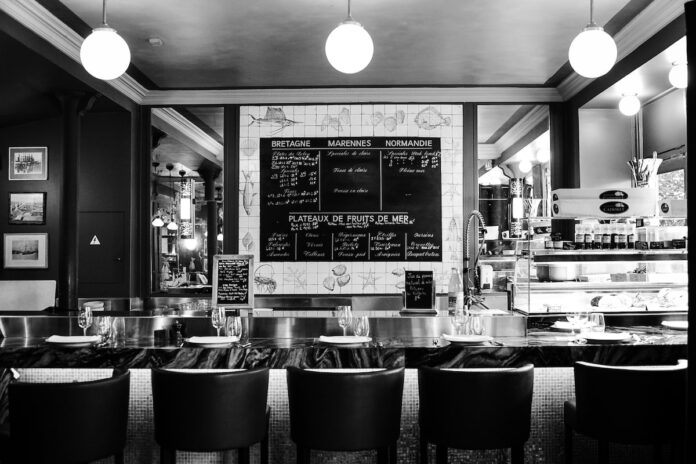

Bon appetit, Paul Bert: An iconic Paris bistro releases its first-ever cookbook. In Paris, there are restaurants and then there are bistros. The former is the more formal option, while the latter is, as the dictionary defines it: small, relatively simple, more relaxed. The ethos at Le Bistrot Paul Bert, in Paris’s lively 11th arrondissement, has always been just that.
The History of Le Bistrot Paul Bert
The location at 18 rue Paul Bert was previously a coal cafe owned by a man from Aveyron; truckfuls of coal that had been shovelled off of trains at the Gare de Lyon were bagged in the rear of the cafe for delivery throughout Paris while the owner’s wife doled out glasses of Avèze, an herbaceous French liqueur, to peddlers and patrons at the bar.
In 1996, Bertrand Auboyneau and his wife, Gwénaëlle Cadoret, bought the cafe, transforming it into an old-meets-new bistro furnished with salvaged Thonet chairs, pendant lights, retro posters and chalkboards with hand-scribbled daily menus. But the bustling conviviality of the bistro’s former incarnation has always remained.
The Food at Le Bistrot Paul Bert
Yet it’s the food – classically French and just as resolutely simple as the setting – that has continued to pack people into Le Bistrot Paul Bert for close to three decades. It’s the place to go for perfectly executed classics: pâté, steak au poivre, sole meunière, leeks vinaigrette, roasted pigeon, île flottante and the delectable gougères that magically appear on each table gratis. There’s also the crowd-pleasing crème caramel.
The bistro – and its masterful cooking – has been frequently name-checked by culinary glitterati such as Anthony Bourdain, Ina Garten and Ruth Reichl.
The Cookbook: French Comfort Food from the Parisian Restaurant
And now, home cooks can replicate some of those dishes in their own kitchens with the release of the establishment’s first cookbook, Le Bistrot Paul Bert: French Comfort Food from the Parisian Restaurant (Abrams).
The promise of a restaurant cookbook can often feel like a pipe dream, a seemingly futile attempt to recreate beloved recipes. But here, many of them are surprisingly accessible and unfussy, approachable enough for the home cook. And while the effect of being in the thick of Le Bistrot Paul Bert’s Paris location, with its intoxicating cornucopia for the senses, may be unmatched, the cookbook might be the most evocative souvenir you can find outside of France.
Conclusion
In one of the short essays prefacing the book, Auboyneau writes that a bistro is a journey taken in place. For those who can’t get to that little street in the 11th arrondissement any time soon, so is this cookbook.
