

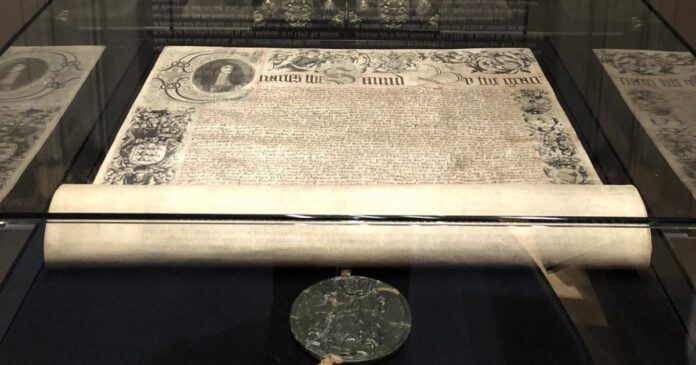

The storied history of Canada’s oldest company, the Hudson’s Bay Co., is encapsulated in a 350-year-old charter. Ensuring the safety and preservation of this significant artifact, which predates Canada itself, requires meticulous care and rigorous attention to detail. The process of moving the Hudson’s Bay charter from Toronto to Winnipeg in the midst of the COVID-19 pandemic, illustrates the complexities and challenges involved in handling such a valuable piece of history.
The Journey of The Hudson’s Bay Charter
The charter was transported on a private plane, carefully shielded in a durable case that maintained a stable temperature and protected it from bright light. Accompanied by a team of conservation and security experts, the charter was safely transported to the Manitoba Museum, where it was meticulously examined for any signs of damage suffered during the transit.
“Some artifacts and belongings that we have are relatively easy to loan to other institutions, to quickly pack and to ship, but this one requires added layers,” said Amelia Fay, director of research, collections and exhibitions at the Manitoba Museum.
Sharing the Artifact Forever
The charter’s journey illustrates the degree of care that four institutions will need to exercise as they share custody of the artifact following the insolvency of the Hudson’s Bay Co. The Thomson and Weston families purchased the charter for $18 million from the company, which has been selling its assets after closing its stores earlier this year. The families will donate the document to The Archives of Manitoba, Manitoba Museum, Canadian Museum of History and Royal Ontario Museum, which will become its permanent custodians.
The Significance of The Hudson’s Bay Charter
The charter, issued by King Charles II on May 2, 1670, is a significant artifact in the company’s collection of 4,400 pieces of art and artifacts. This animal skin document set the stage for the company’s fur trading empire and played a crucial role in the country’s colonialization before Confederation. The charter granted Hudson’s Bay Co., then known as the “Governor and Company of Adventurers of England Trading into Hudson’s Bay,” control over one-third of modern Canada and Indigenous relations for the coming decades.
Preserving the Charter: A Complex Task
The preservation of such a historical document is intricate and requires constant security, controlled lighting, and stable temperatures. The seal of the charter, now dark brown with age and wear, is particularly fragile and requires extra padding during shipping. The charter is typically unrolled and displayed on a slight incline, encased in a modern enclosure equipped with sensors to log any changes in conditions inside the case.
The Manitoba Museum, which already houses a 28,000-item collection donated by Hudson’s Bay Co. in 1994, was entrusted with the charter from September 2020 to December 2021. The museum’s staff followed strict protocols to ensure the document’s integrity was maintained during its stay.
Future Plans for The Hudson’s Bay Charter
Once the Thomson and Weston purchase closes, the charter will be assessed by the Canadian Conservation Institute to determine its condition and to advise on how it should be transported. A $5 million donation from the Thompsons and Westons, along with additional support from the Desmarais and Hennick families, will aid in the charter’s preservation.
However, the timeline for the final move of the charter is yet to be established. “It’s not something you can just throw together really quickly,” Fay said. “This requires … careful consideration, so it’s not something we will rush into.”
This report by The Canadian Press was first published Dec. 12, 2025.
