

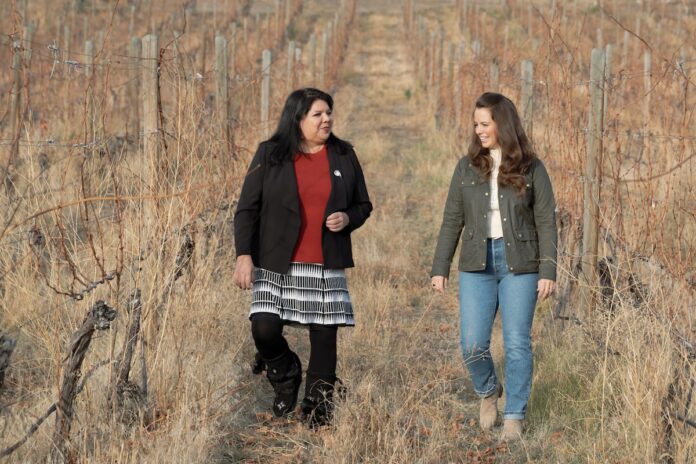

A new generation of Indigenous tastemakers is energizing the Okanagan Valley. For several years, as harvest got under way in British Columbia’s Okanagan Valley, Cree sommelier and chef Eliana Bray poured a bottle of the previous year’s vintage over the first bushels of freshly picked grapes destined to become wine. Standing by the press amid glassy blue lakes and ochre-tinged hills lined with vineyards, she performed a ritual rooted in Indigenous custom, paying homage to nature’s abundance.
“Indigenous culture is helping to redefine winemaking in the Okanagan Valley,” says Bray, who wears bronze and silver wrist cuffs inspired by her childhood hero, Wonder Woman. She also designed a logo of a feisty masked ninja reimagined as a wine bottle to represent herself online. “My nose and my palate are my superpowers,” she adds.
Nk’Mip Cellars is owned by the Osoyoos Indian Band in Osoyoos, B.C.
Aaron Hemens/The Globe and Mail
Bray is part of a new generation of Indigenous winemakers, sommeliers, and winery owners reshaping the culture of wine in the Okanagan – a valley of rare, ethereal beauty that often enjoys as many as 13 hours of sunshine a day during the peak summer months, and which has emerged as one of Canada’s most promising wine regions.
Bray, who has worked at acclaimed wineries including Mission Hill Family Estate and Roche Wines, recently started Cree-ation Nation, merging her viticulture training with Cree customs. In January, she’ll begin crossing the valley in a mobile food and wine-tasting trailer emblazoned with a red eagle, pairing Indigenous dishes like bison burgers and smoked salmon with local pinots and sparkling wines.
Tucked roughly four to five hours east of Vancouver by car, the valley is gaining recognition alongside better-known wine centres such as Bordeaux, Tuscany, Napa, and Rioja, forcing even snooty oenophiles to take notice of Canadian wine with labels such as Little Engine, Moon Curser Vineyards, Laughing Stock, and Painted Rock.
Such is the growing cachet of the region that a three-litre bottle of Little Engine’s 2019 Union, an upmarket Bordeaux-style blend, sells for $788 at Mott 32, a swoon-worthy Chinese restaurant in Vancouver, while the 2020 Painted Rock Cabernet Franc lists for nearly $300 at the Braywood, a stylish modern British restaurant in the Berkshire countryside, close to London.
Once known for its ice wine, apple and cherry orchards, and pot-smoking backpackers on budget holidays, the Okanagan has undergone a striking makeover in recent years. It now hosts memorable high-end venues such as Elma, a sleek, lakeside Turkish restaurant with the authentic swagger of Istanbul’s finest kitchens, and the Restaurant at Poplar Grove, featuring foraged ingredients, savvy wine pairings, and sweeping vistas of Okanagan Lake.
Competing with Ontario’s Niagara Peninsula, Quebec’s Eastern Townships, and Nova Scotia’s Annapolis Valley for high-spending wine-tasting tourists, the region is increasingly drawing comparisons to Napa for its ambition and quality.
In an era when locally sourced ingredients are a national obsession, the Okanagan’s growing reputation is being shaped by Indigenous peoples, who for centuries cultivated native plants, and hunted elk and deer across the area’s scrubby slopes. Now, that ancestral bond with the land is being reimagined with a new mission: producing memorable glasses of cabernet sauvignon.
Aaron Hemens/The Globe and Mail
Indigenous winemakers build on the legacy of Nk’Mip Cellars (pronounced Ink-a-meep), which calls itself Canada’s first Indigenous-owned and operated winery. Owned by the Osoyoos Indian Band, it sits on a reserve that encompasses 32,000 acres of semi-arid desert land.
On a recent afternoon during harvesting season at Nk’Mip, the land was alive with the motion of winemaking. Forklifts carrying bins of grapes darted across the crush pad, where they are pressed for juice. The air was thick with the sweet, pungent scent of fermenting grapes.
Taking a rare break from the harvest, chief winemaker Justin Hall, a former mechanic, said that winemaking had become a source of cultural affirmation, financial independence, employment, and social development for the band’s 600 members.
“It’s taking something that people said couldn’t grow here and making it thrive,” Hall said.
For centuries, the band’s livelihood was tied to the land through trapping, hunting, and agricultural labour. After years of leasing some of its land, the band opened Nk’Mip in 2002, joining forces with Arterra Wines Canada, but retaining majority control.
Since its inception, proceeds from the winery and land leases – about $25-million to $30-million in total – have helped pay for university degrees, housing, health care, and monthly pensions for elders. Hall proudly noted the winery had a part in funding a band member’s $275,000 law degree, making her the community’s first lawyer.
Justin Hall, chief winemaker for Nk’Mip Cellars, says winemaking has become a source of cultural affirmation.
Aaron Hemens/The Globe and Mail
Nk’Mip’s Indigenous identity is embedded throughout the winery: Its earth-toned buildings feature motifs inspired by local flora and fauna, and its wine labels depict a crow, stylized deer, and a rising sun. You’ll find it on Dreamcatcher, its most popular white, a blend of riesling, ehrenfelser, sauvignon blanc, pinot blanc, chardonnay, and sémillon. (Talon, a blend of syrah, cabernet sauvignon, malbec, and cabernet franc, is its most popular red.)
“People see our wine, and they see our tribe,” Hall said.
While Nk’Mip was the pioneer among Indigenous winemakers, Bray is part of a broader shift taking place in the Okanagan Valley, including the ascent of Indigenous women in an industry that, she observed, was long perceived as being elitist and dominated by white men.
Bray has worked in all aspects of winemaking, from picking grapes to running a winery. She has since honed a palate so refined that she can identify decades-old sakes and rare bottles of Pauillac blindfolded. During impassioned tastings, she describes wine as if it were alive, peppering her tasting notes with references to the sun, the moon, the water, and the Earth.
For Bray, wine has become a vessel for creativity, enterprise, and connecting people.
Born into the Kehewin Cree Nation, she was adopted into a white family in Alberta and grew up disconnected from her heritage – one of thousands of Indigenous children taken from their families during the Sixties Scoop, a government assimilation policy that decimated many communities.
Lyndsay Manyluk/Globe And Mail
But, she said, the scars of the past began to heal thanks to a chance encounter at CedarCreek Estate Winery in Kelowna. While giving a wine-tasting, Bray met an investigative reporter who offered to help her find her biological family.
“I thought she was crazy,” Bray recalled. But within days, she met her half-sister, and, eventually, her brother, learning that her Indigenous lineage stretched back to the 19th century.
“You could say that wine helped me rediscover my Indigenous roots,” she said.
Initially, Bray, who trained to be a music therapist, said she felt that the wine industry was a rarefied world off limits to people like her. But that only made her more determined.
After switching to sommelier school, she saw parallels between winemaking and Cree practices like the moose hunt: both demand patience, acute attention to detail, and reciprocity – taking only what is needed from nature and giving back.
Other Indigenous people working in the Okanagan wine industry say that discovering the art of wine has been a source of reclamation.
Karen Chapman, a member of the Cowichan Tribes on Vancouver Island, who works in the tasting room at Black Market Wine Company in the Okanagan Valley, said that when she arrived in the region eight years ago, she initially felt that an Indigenous person shouldn’t work in the wine world. Her grandparents attended residential schools and her mother, buffeted by intergenerational trauma, struggled with alcoholism. Her mother has since overcome her addiction and has remained sober for more than 40 years.
While alcohol was banned and stigmatized where she grew up, she said that her decision to go into the wine industry helped turn a substance once associated with family pain into a source of cultural pride and celebration.
A grapevine hangs at the vineyards at Nk’Mip Cellars, which was founded by the Osoyoos Indian Band.
Aaron Hemens/The Globe and Mail
“We should never forget what happened in the past,” she said. “But wine has become a way for me to grow, to become self-sufficient, to rejoice in my culture.”
At the beginning of each season, Chapman sprinkles a mix of sweetgrass, cedar, sage, and tobacco on the vines to honor the land. Some winemakers also leave an empty chair at wine tastings in a quiet gesture of respect for their First Nation’s elders.
Chapman is working with other Indigenous women to help break down barriers, including the high costs of viticulture and sommelier courses, which can range from roughly $1,000 for shorter programs up to $20,000 or more for advanced diplomas. She is a board member of the Vinica Education Society, which helps women and those from BIPOC and other under-represented groups enter the wine industry; it helped fund her wine studies.
Success doesn’t come easy, however.
Hall observed that winemakers also face forest fires, freezing weather, and grape-guzzling bears.
Winemakers also face forest fires, freezing weather, and grape-guzzling bears.
Aaron Hemens/The Globe and Mail
Last year’s brutal freeze killed nearly a third of Nk’Mip’s vines, forcing the winery to import grapes from Washington State. And while fires threaten vineyards and can make fine wines taste smoky, it takes just a few cabernet-loving bears to devour $15,000 worth of grapes in a few days.
There is another hurdle that many winemakers find even more insidious. More than a century after Prohibition-era restrictions shaped Canada’s wine laws, much of British Columbia’s wine is still only sold within the province, constrained by alcohol laws that often make interprovincial shipments of Canadian wine difficult. While provinces, spurred by U.S. tariffs, recently eased many interprovincial trade barriers, alcohol remains restricted.
Some years ago, a local winemaker successfully ordered a 12-gauge shotgun from Saskatchewan to the Okanagan by mail in a stunt aimed at showing that it was easier to ship firearms than pinot noir.
In July of 2024, British Columbia and Alberta signed an agreement to allow direct shipments of B.C. wine to Alberta consumers. But in Ontario and Quebec, the country’s two largest wine markets, major barriers remain. Many Okanagan winemakers bypass rules by shipping wine in unmarked boxes via a medical supplies company.
“It’s frustrating – we can import wine from all over the world, but we can’t sell ours freely across Canada,” said Hall.
Perched high in the hills of West Kelowna on the valley’s western slope sits Niche Wine Company, a family-owned producer that crafts small-batch pinot noir from seven acres of estate vines.
Lyndsay Manyluk / Globe And Mail
Joanna Schlosser, co-owner of the winery and a member of the Squamish Nation, lamented that Canada’s labyrinthine regulations were impeding wineries like Niche that produce small volumes. Like many Okanagan wineries, Niche operates a wine club to reach consumers directly, though only a handful of provinces, including British Columbia, Alberta, Nova Scotia, and Manitoba, allow some direct shipments of Canadian wine to consumers.
Regulatory frustrations aside, Schlosser said that winemaking was expanding the notion of Indigenous culture in a country that often dwelled on Indigenous suffering and resilience.
“Wine allows me to celebrate Indigenous identity not only as resilience, but as joy, creativity, and entrepreneurship,” she said. One of her playful tasting notes suggests pairing one of Niche’s full-bodied reds “with a great cut of meat and a whole lot of Leonard Cohen.”
A former Air Canada flight attendant, Schlosser said she became captivated by both the craft of wine and her husband, James, when she met him in Toronto while he was pursuing a master’s in oenology and viticulture.
When the two decided to plant vineyards more than two decades ago and pursue their dream of owning a winery, they dug for weeks with the help of Schlosser’s family, until they discovered groundwater – an essential source of irrigation for most vineyards in the Okanagan’s dry climate.
“Soon, bursts of butterflies and dragonflies appeared, while quail suddenly scurried across the estate,” she said, with a mix of awe and admiration.
“Every bottle tells a story,” she said. “It’s a way to express connection – to the land and to each other.”
