

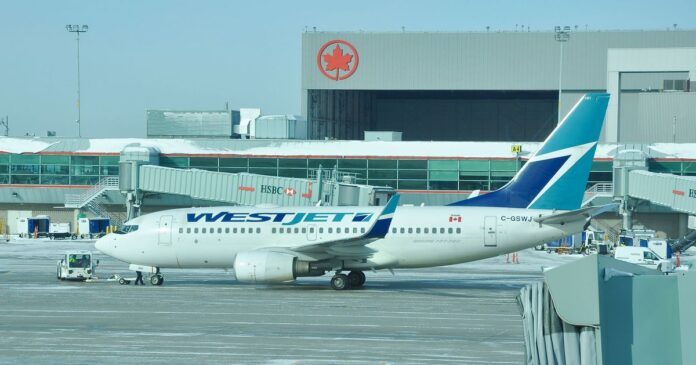

Canadians should stop holding out hope that air travel will ever get cheaper. This rather disheartening prediction comes straight from Federal Minister of Transport and Government House Leader Steven MacKinnon. In a recent session with the Greater Vancouver Board of Trade, MacKinnon outlined the factors that make air travel within Canada a costly affair.
Understanding the High Cost of Domestic Air Travel in Canada
MacKinnon acknowledged the longstanding frustration among the Canadian public over the high cost of domestic air travel, especially for journeys between smaller and remote communities. Canadians are feeling the heat of not only rising airfares but also the additional costs for services that were once included in the base fare. This has added to the economic stress of Canadians, who are grappling with stagnating wage growth and economic uncertainties.
MacKinnon cited several instances to illustrate the situation. For example, in 2024, WestJet started charging for carry-on baggage on its basic economy domestic and U.S. transborder flights, a policy that Air Canada adopted in 2025. WestJet further stirred the pot by reconfiguring its economy cabins to denser seating layouts and non-reclining seats in September 2025. This move was put on pause due to consumer backlash.
Canada’s Geographic and Market Realities
The Minister outlined that the current state of air travel is a result of structural challenges rather than opportunistic strategies by airlines. Canada’s vast geography and harsh climate present unique difficulties for air service providers. “We have a very big country, and it’s a Nordic country, and it’s tough to provide air services in Canada,” MacKinnon stated.
He also threw light on the fact that most international airlines are interested only in serving major Canadian hubs like Vancouver International Airport and Toronto Pearson International Airport, making it economically challenging to service smaller communities like Kelowna, Bathurst, New Brunswick, or Wabush, Labrador. Despite these challenges, domestic airlines like Air Canada and WestJet, along with smaller regional carriers, continue to connect these remote areas. However, the operating costs in Canada invariably result in higher airfares for passengers.
Supporting National Airlines amid High-Cost Structures
Steven MacKinnon. (Greater Vancouver Board of Trade)
MacKinnon emphasized the importance of supporting national airlines like Air Canada, WestJet, and the rapidly expanding Porter Airlines, despite their high-cost structures. He addressed the fact that it is often cheaper to fly internationally than domestically from Canada, attributing it to economies of scale and more predictable flying conditions in destinations like Los Angeles compared to northern cities like Yellowknife.
External Factors Impacting Canadian Air Travel
Canada’s airlines are also grappling with higher structural costs, including fuel and labour, which add further pressure on fares and operations. For instance, Air Canada’s flight attendant strike in 2025 disrupted flights nationwide, leading to a revised financial outlook for the airline. WestJet, too, has faced labour tensions, further underscoring the cost pressures associated with airline workforces.
On top of these, public policy think tank MEI has pointed out that taxes and fee structures also contribute significantly to the high airfares in Canada. Unlike in the U.S., Canadian airports operate on a user-pay model, with costs passed on to travelers through taxes, security charges, and airport fees. MEI argues that these fees are often higher than in comparable jurisdictions, undermining the argument that weather and distance are the primary cost drivers in Canada.
Given these complex factors, MacKinnon urged Canadians to be realistic about the limits imposed by geography and market forces. “I do think it’s important that folks hear from a transport minister that there are natural factors that make air travel in Canada an expensive proposition,” he concluded.
