

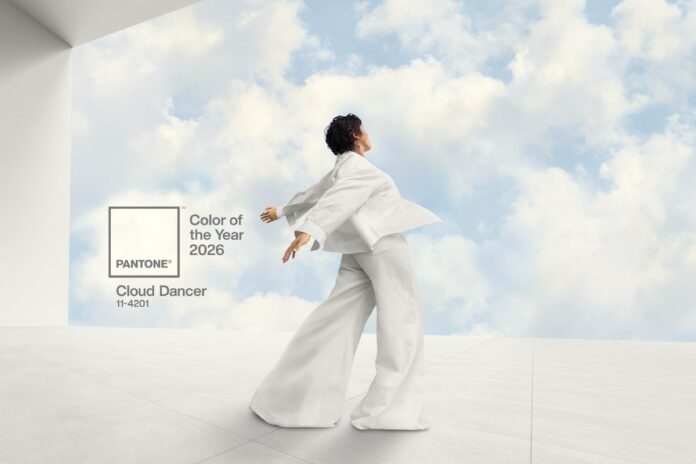

Inside the world of colour forecasting, a key ritual has emerged in recent years – the announcement of Pantone’s Colour of the Year. This tradition, which began in 1999, is aimed at highlighting the influence of colour on culture and engaging with global design communities. In 2026, Pantone made a controversial pick for its Colour of the Year, Cloud Dancer, which has elicited widespread bewilderment and sparked numerous discussions on its implications and significance.
The Controversy Around Pantone’s 2026 Colour of the Year
Every year, Pantone’s Colour of the Year announcement is eagerly anticipated by the design world. This year, however, the selection of Cloud Dancer, a shade of white, has caused quite a stir. This is the first time that a “non-colour” has been selected, following the vibrant Viva Magenta and Mocha Mousse choices of previous years. The selection has led to widespread bewilderment, with social media users dubbing the colour “Landlord White” and comparing it to the minimalist corridors of fictional corporations in dystopian narratives.
However, Pantone, in their announcement, described Cloud Dancer as a “discrete white hue offering a promise of clarity”. They argue that in a time of transformation and reimagining of our future, this colour provides a sense of clarity and simplicity. However, the choice is not without its controversies, with some critics drawing parallels to historical and political associations of white with racial purity and fascism.
The Art and Science of Colour Forecasting
Colour forecasting is not merely an arbitrary process. It is a combination of art and science, involving an in-depth understanding of cultural shifts, societal moods, and emerging influences. Pantone and other colour forecasting companies, like PPG, devote significant resources to developing their annual colour picks. At PPG, for instance, a team of 36 stylists spend a week in immersive workshops analysing various cultural and societal factors to arrive at their Colour of the Year.
While Pantone’s choice has been a stark white, PPG’s 2026 Colour of the Year is Secret Safari, a striking botanical shade that evokes feelings of simplicity, comfort, and familiarity. This suggests a divergence in colour forecasting, with different companies interpreting societal trends and moods in varied ways.
The Impact of Colour Forecasting on Industries
Colour forecasting plays a significant role in various industries, from fashion and home decor to automotive and consumer electronics. For instance, Volvo’s design direction and colour trends typically feature warm neutrals such as granite, sandy taupe, and coastal blue, aiming to evoke emotion and a sense of calm. Similarly, paint brands like Benjamin Moore and Sherwin-Williams also release their own Colours of the Year, influencing trends in home decor and interior design.
However, measuring the success of these colour predictions can be challenging, especially in industries with longer product release cycles. A rise in sales following a colour announcement can indicate success in the consumer paint industry, but it’s more complex in the automotive industry, for example.
Understanding the Implications of Pantone’s 2026 Colour of the Year
In light of Pantone’s controversial pick, it’s interesting to note that other designers are forecasting a 2026 palette of earthy, dramatic hues, with deep browns, greens, and reds leading the shift toward maximalism and eclecticism. This suggests that Pantone’s Cloud Dancer might either be a misstep or an accurate reflection of a societal shift towards minimalism and simplicity. Regardless of the controversy, Pantone’s Colour of the Year continues to spark important conversations about the role of colour in our lives, and its influence on our moods, behaviours, and cultural trends.
