

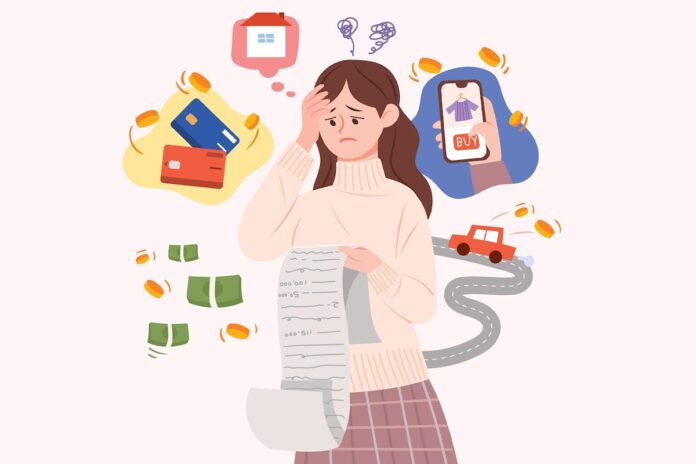

In this personal and financial journey, we meet Ella, a 44-year-old public sector lawyer from the Greater Toronto Area (GTA), who earns an annual income of $210,000. Despite her impressive salary, Ella’s financial situation is complicated by a heavy mortgage of $707,000 and consumer proposal debt of $106,500. The latter is a consequence of an episode of manic spending, a symptom of her bipolar disorder. This article will delve into Ella’s financial situation, her struggles, and the steps she’s taking towards financial recovery.
Understanding Ella’s Financial Situation
Ella’s savings account holds $6,000, and she has $65,000 in a registered retirement savings plan and $35,000 in a registered education savings plan (RESP) for her daughter. However, her primary financial concern is creating enough of a cushion to survive without credit, a task complicated by the competing priorities between her emergency fund and RESP.
Ella’s bipolar disorder has led to episodes of uninhibited spending, which has resulted in considerable financial strain. “I had no wiggle room financially and was on this crazy bonanza and wasn’t paying attention,” Ella recalls. She accrued a debt of $160,000 on her line of credit and credit card during one of these episodes.
Steps Towards Financial Recovery
It was the shock of tracking her spending and facing the reality of her situation that served as a wake-up call for Ella. She sought help from a licensed insolvency trustee, who worked out a consumer proposal with her creditors. She now pays back $1,775 monthly for 60 months, totalling $106,500 of the original $160,000 she owed.
As part of her financial recovery plan, Ella has made significant lifestyle adjustments. She has given up her gym membership, deleted all food apps from her phone, and transitioned to a “cash lifestyle”, paying for her needs with physical money instead of credit.
Family Life and Financial Responsibilities
Ella lives in a small three-bedroom townhouse with her partner and tween daughter from a previous relationship. Her partner contributes about $1,500 monthly towards household expenses. Moreover, Ella strives to shield her daughter from her financial struggles as much as possible, even sometimes buying takeout for her daughter while saving money by not eating out herself.
Her priorities now are building an emergency fund and growing her daughter’s RESP. “Postsecondary school is going to start sooner than I think,” Ella says, indicating her concern for her daughter’s future.
A Snapshot of Ella’s Monthly Expenses
Ella’s monthly expenses provide a revealing insight into her financial commitments. Some major monthly expenses include $3,040 towards investments and savings, $5,347 towards servicing her debt, $1,792 for household and transportation, and $900 on food and drink. Her miscellaneous expenses add up to $4,875, which includes income tax, child support, entertainment, streaming services, personal care items, sports for her child, and other necessities.
Despite her financial pressures, Ella remains committed to financial recovery, determined to provide for her daughter, and continue building a secure future. Her story serves as a reminder that financial stability is not just about earning a high income, but also about managing money wisely, planning for the future, and seeking help when needed.
If you’re a millennial or Gen Z and would like to participate in the Paycheque Project, fill out the form below or send an email to Roma Luciw at rluciw@globeandmail.com. Please include your name, age, where you live, occupation, your biggest financial concern and your email. And remember, Paycheque Project is a judgement-free zone.
