


Ukraine willing to share drone and military technology with Canada, envoy says
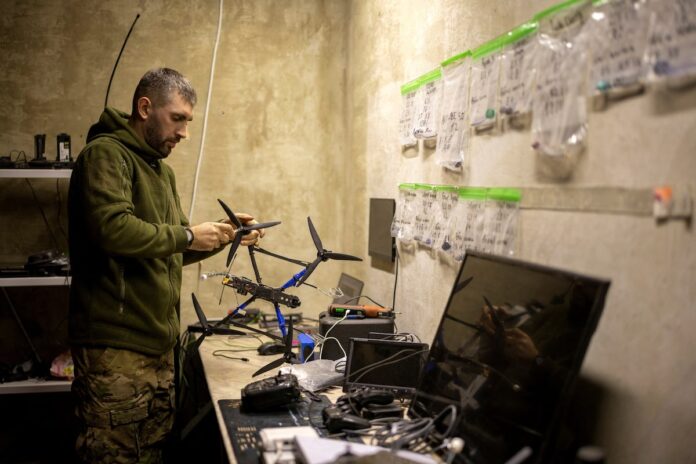
Ukraine is willing to share its military technology, including drones, with Canada either by selling it or through joint production, Kyiv’s envoy told MPs Tuesday.
Drone Innovation in Ukraine
Ukraine, under assault from Russia, has become an expert in drone warfare innovation with the evolution of technology happening at a rapid pace, as they play a central role in the conflict.
Andrii Plakhotniuk, Ukraine’s ambassador to Canada, was asked at the Commons defence committee Tuesday how Kyiv could help the Canadian government acquire new military technology including drones.
He told MPs co-operation on joint defence production is already under way. Ukraine is ready “to share our knowledge, our technological knowledge, with all our partners and reliable friends.”
Reducing Reliance on U.S. for Military Equipment
Prime Minister Mark Carney’s government is trying to reduce its reliance on the United States for military equipment. Canada currently gets about 75 per cent of its defence equipment south of the border.
Joint Defence Production
Mr. Plakhotniuk said the question would be where can military equipment be produced the most rapidly.
“Certainly we can produce more and quickly in Ukraine because we are prepared to do that for our survival,” the envoy said.
“If we can produce faster in Ukraine, then we should produce in Ukraine. If we can produce strategically somewhere else, let’s explore this opportunity.”
Canadian Joint Forces Command
The head of Canada’s new Canadian Joint Forces Command Lieutenant-General Darcy Molstad said in a recent interview that the Canadian navy, the air force and the army are all working on drone and counterdrone measures. But he wants to find ways to “break down silos” and bring technology to all branches at a faster pace and at greater scale.
The question is how to do that.
Energy Crisis in Ukraine
Russia’s attacks on infrastructure have left Ukrainians without sufficient power for the winter.
“Even in the city of Kyiv, which I think is one of the best protected places in Ukraine, during the day there could be times when we don’t have electricity supply for up to 16 hours,” Mr. Plakhotniuk told MPs.
“This illustrates the critical situation we are now facing.”
Russia has sharply increased both the number and intensity of attacks on Ukrainian gas and energy infrastructure in recent months, targeting both power-generation facilities and electricity-transmission systems.
Ukraine operates three nuclear power plants, which produce more than 50 per cent of all electricity, but the plants are forced to reduce production owing to damage to power lines.
The energy shortage is forcing power grid operator Ukrenergo to restrict supplies to consumers, plunging entire regions into darkness. Power cuts also affect heat and water supplies.
Canadian Support for Ukraine
Mr. Plakhotniuk said Ukraine is grateful for Canadian support, including a $200-million donation for military equipment last week. Canadian aid to Ukraine since Russia’s all-out assault began in February, 2022, totals about $22-billion.
He said not everything can be obtained from Canada when it comes to rebuilding Ukraine’s power grid because of different electrical systems.
Canadians or other countries or supporters could help “in a quick way” by sending funds to European Union partners “so this equipment could be bought on European markets and delivered as soon as possible to the Ukrainian side,” he said.
The World Bank’s latest estimate, released Feb. 25, pegs Ukraine’s reconstruction and recovery needs at US$524-billion over the next decade – 2.8 times its 2024 GDP – as of Dec. 31, 2024.
With reports from Reuters
