

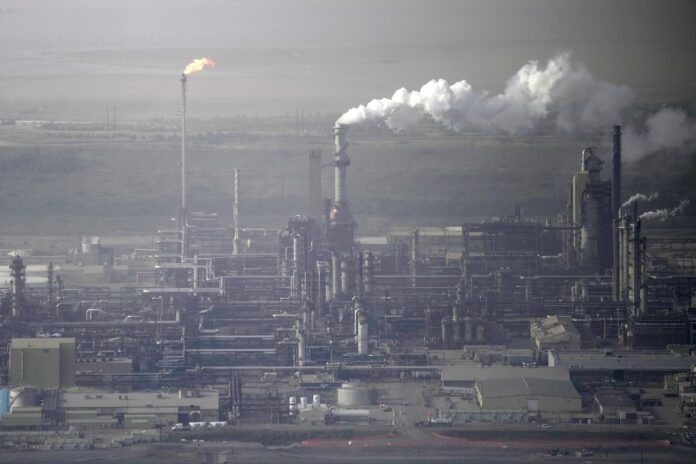

A groundbreaking collaboration is on the horizon as Mantel Capture Inc., a Boston-based start-up, joins forces with an undisclosed Canadian oil producer to launch a carbon capture study in Alberta’s oil sands. With the innovative technology that Mantel offers, the cost of carbon capture could be slashed by half, signifying a monumental stride in the effort to reduce carbon emissions.
Mantel Capture Inc.’s Technology and the Oil and Gas Sector
As the world races to combat climate change, Mantel Capture Inc.’s venture into the oil and gas industry couldn’t be timelier. The company’s technology received a significant boost under the energy accord signed last month by Ottawa and Alberta. This agreement, featuring the Pathways Project, plans for a 400-kilometre pipeline that will transport carbon emissions to an underground storage hub, with its construction aimed for completion by 2040.
The Pragmatic Solution to Carbon Capture
The CEO of Mantel, Cameron Halliday, expressed optimism about the future of carbon capture amidst uncertain policy changes at the federal and provincial levels. According to Halliday, the signs all point to carbon capture as the pragmatic solution that people can rally around.
Mantel’s Pilot Projects and Expansion Plans
Mantel’s technology has already been tested in a demonstration carbon capture and storage (CCS) project at Kruger Inc.’s Wayagamack pulp and paper mill in Quebec. This project aims to capture 2,000 tonnes of carbon dioxide each year. The partnership with the Canadian oil producer, however, significantly scales up this endeavor with a goal to capture approximately 60,000 tonnes of CO2 annually.
Traditional vs. Mantel’s Carbon Capture Technology
Traditional carbon capture methods consume massive amounts of energy in the form of steam, leading to high operational costs. On the contrary, Mantel’s technology produces steam as an end-product, which can then be used in on-site industrial processes.
Unveiling Plans for a Major Carbon Capture Facility
While the name of the partnering oil producer remains undisclosed, it is known that the company is a steam-assisted gravity drainage (SAG-D) operator in the Cold Lake basin, about 300 kilometers northeast of Edmonton. These sites use steam to heat and thin the heavy oil, enabling it to flow into a well for extraction. This efficient use of steam makes Mantel’s technology a perfect fit for these operations.
Financial Attractiveness and Policy Environment
For a project to attract investment, it needs to be financially appealing and fostered by an encouraging policy environment. According to Clean Prosperity, a climate policy think tank, the memorandum of understanding between Alberta and Ottawa has the potential to attract over $90-billion in low-carbon capital investment, with the bulk focusing on the CCS space.
Canada’s Approach and the Future of Carbon Capture
Canada’s unique approach of combining a CCS investment tax credit with a price on carbon provides motivation for companies to reduce their emissions. With Mantel’s technology reducing the cost of carbon capture by around 50%, the future of this industry looks promising.
Support from Alberta Innovates
Alberta Innovates, a Crown corporation that provides funding for research, innovation, and entrepreneurship across various economic sectors, is partly supporting Mantel’s project. This collaboration will leverage Alberta’s deep technical expertise in finding emissions-reducing solutions.
Projected Timeline for the Project
The engineering-design study for Mantel’s oil sands project is expected to conclude toward the end of 2026. Following a final investment decision, the project is anticipated to commence approximately two years later.
