

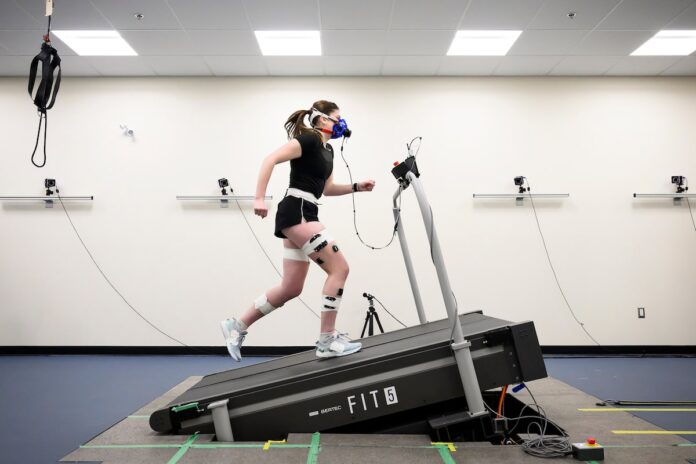

Imagine a future where your clothes and accessories can monitor your health, adjust to environmental conditions, and even help with physical challenges. This is not just a sci-fi dream, but a reality being brought to life in the WearTech Labs at Simon Fraser University in Burnaby, B.C. Under the guidance of Dr. Max Donelan, a professor of biomedical physiology and kinesiology, and his team, they’re pushing the boundaries of wearable technology, merging the complexity of the human body with the possibilities of advanced technology.
WearTech Labs: A Laboratory for the Future of Wearable Technology
Dr. Donelan’s playground is a collection of various machines – industrial sewing machines for fabricating, machines for printing electronics onto fabric, specialized treadmills for measuring foot impact, and more. But the real marvel at the center is the human body, the ultimate machine that technology seeks to enhance.
“The whole question is, how do you effectively work with the human body?” said Dr. Donelan. “When you’re creating technology to help the body achieve something, the tech is always the least complicated partner in the marriage.”
WearTech Labs is a newly opened facility at SFU, offering businesses the chance to develop and test wearable technologies with human subjects. It is a unique research complex for rapid prototyping and analysis, integrating human science with advanced technology. This $17-million project is partly funded by federal and provincial grants, and partly by SFU itself.
Advancing Wearable Technology through Collaboration
Dr. Donelan and the project’s co-leader, Dr. Ed Park, have a vision to facilitate breakthroughs in wearables, creating world-class devices that find use in clinics, workplaces, and homes. The idea is to help Canadian companies build high-quality wearable tech that can be used by the public.
“We want to see breakthroughs in wearables, so that those wearables are used in clinics, workplaces and homes,” says Dr. Park, a professor of mechatronics and robotics at SFU.
The facility is equipped to create prototypes with embedded devices for testing. It also features environmental rooms for subjecting people and wearables to extreme conditions, a wind tunnel for testing performance gear, and a sleep room for testing devices designed to gather data during sleep.
Impacts and Opportunities in the Wearable Tech Industry
The timing of WearTech Labs couldn’t be better. With advancements in materials, AI, and an increased concern for health and mobility in an aging population, consumer demand for wearable technology is ripe for acceleration. The lab offers a model for private-public collaboration set up to work on industry questions at industry speed, addressing Canada’s need for increased research and development activity.
One of the companies benefiting from this collaboration is Hettas, a Vancouver-based company that makes high-performance running shoes for women. By working with WearTech Labs, they have been able to base their designs on research and data, addressing the scarcity of data on how women’s feet change as they age, and how bones, ligaments, and muscles respond to shifting hormone levels and other sex-specific variables.
Conclusion
WearTech Labs offers an exciting and promising future for wearable technology. By combining scientific expertise with industry needs, it is paving the way for innovative products that can improve our health, comfort, and quality of life. As Dr. Donelan said, “If wearable technology is going to become an important and widespread element in our lives, there will need to be a lot of validation and testing. WearTech Labs is designed to make that possible.”
